
Last week I had the absolute honour of speaking at the ‘Rhyme & Reality: Youth Work in the Booth” event organised by a research collective from Queen Mary’s University. It was held at WeAreSpotlight in E14. The event was hosted by Richard Roache aka Roachee (Roll Deep), Heather McMullen and Elinor Whittle at QMUL who are conducting such important research exploring the relationship between music, youth work and violence prevention as part of TheHealStudy.
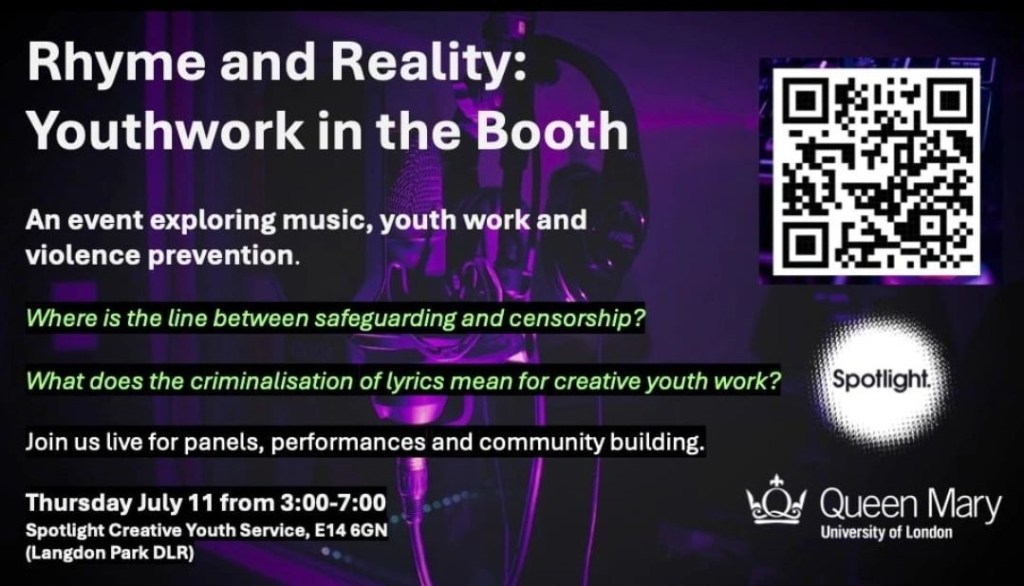
They posed brave and important questions around how youth workers use music and music production facilities to engage young people, but yet also safeguard them regarding their use of lyrics/themes which may end up causing them further harm or risk. To bring this to life there were several brilliant young musicians who performed their music (recorded at Spotlight) and then engaged in a panel discussion about their lyrics and how they navigate their artistic process and expression. The young artists included The Hitrz (on spotify), Jthewriter @jtwonline and Gwen Stacy (formerly Diamond) (on spotify). Slix (Ruff Sqwad) co-hosted the panel.
It really highlighted the importance of actually asking young people directly about their experiences, expression, and music. So often people are trying to work this out from afar instead of engaging with musicians themselves.
It was a real honour to be part of a later panel to discuss these issues, hosted by Richard joined by Dr Lambros Fatsis who discussed racism and ‘chryme’ (the criminalisation of drill music lyrics), Ciaran Thapar who talked about his experience as an expert witness, as well as Slix and Indie Max who reflected on creative youth work in practice.
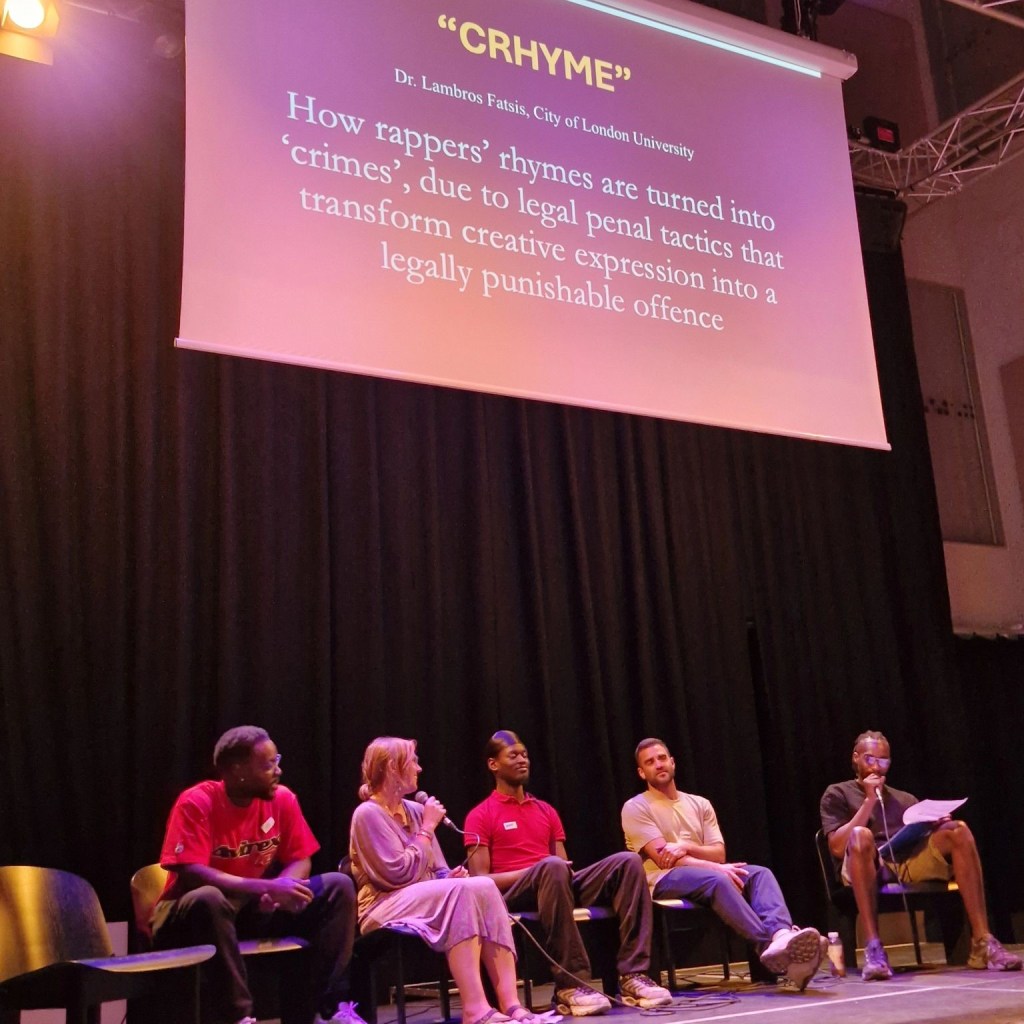
For my contribution I talked about music elicitation as a listening tool- why it works as a way to engage with people and connect through our differences through the universality of music. I outlined the ways in which music elicitation is effective; as a narrative tool; as a communication tool; as a way to create bridges of understanding. I shared the way that I think music elicitation disrupts traditional power dynamics to place the control for curation in the hands of the young person, creating trust and spaces for listening. I am a big fan of the unstructured interview space in this context- where no pre-planned questions are asked, but rather the participant can talk about what matters to them. In my recent work in Albania we piloted music elicitation as a youth work tool, and I shared the way in which ‘mattering’ (Billingham & Irwin-Rogers, 2021; Flett, 2018; Prilleltensky & Prilleltensky, 2021) makes sense, that actually we all want to be heard, valued, and to matter, that includes ‘professionals’. In that study I found that youth workers also loved to share their music, and that the power of the method is that it cuts through hierarchies and roles to get to the heart of our common humanity. I have theorised this as ‘sonic mattering’ in my new book. We can connect with people whose lives are vastly different through a shared appreciation of music, storytelling, and authentic listening.
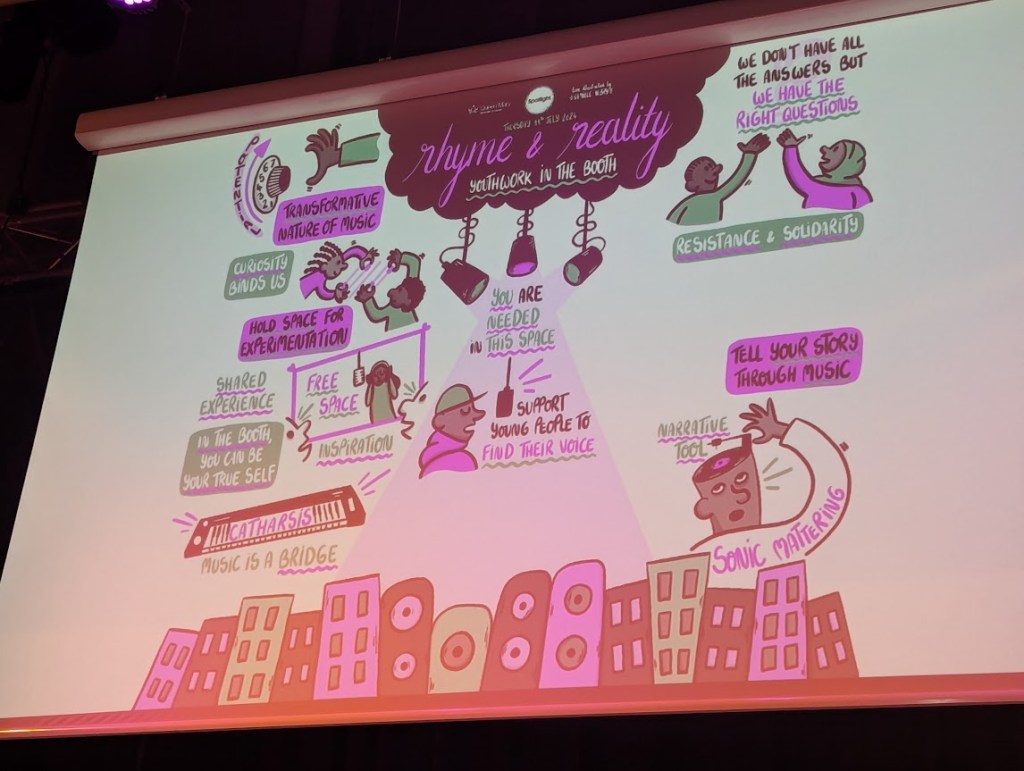
It was quite a moment for me to see this idea noted on the board at the end. I have always said that the value of research only lies in how it is used in practice to better the lives of those it seeks to reach. I wonder now whether these ideas will be tested in practice. It meant a lot to be invited into this space to share my work.
 jadelevell.com